© Studio 4°C (Horipro involvement)www.netflix.com
Berserk: The Golden Age Arc III - The Advent
Overview
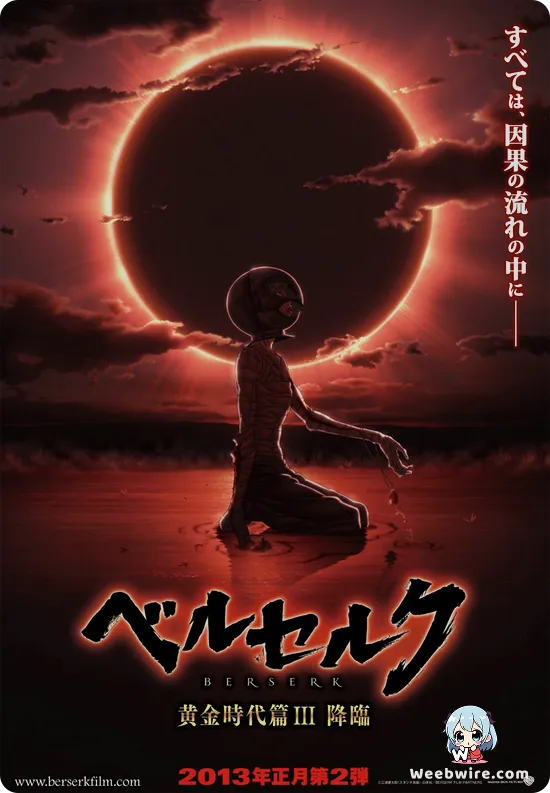
Berserk: The Golden Age Arc III - The Advent marks the harrowing conclusion to the Golden Age Arc film trilogy, faithfully adapting Kentaro Miura's seminal manga into a dark fantasy epic. The narrative unfolds within a brutal medieval world plagued by ceaseless warfare and lurking supernatural horrors. Set one year after Guts' departure from the Band of the Hawk to pursue his own path, the once-celebrated mercenary group finds themselves branded as fugitives, relentlessly pursued by Midland's forces. Under the determined leadership of Casca, who steps up in Griffith's absence, the surviving Hawks embark on a perilous rescue mission to free their imprisoned commander from the Tower of Conviction. Griffith endures torturous captivity that leaves him physically and mentally broken. Guts, compelled by lingering bonds and a sense of unresolved duty, rejoins the effort, leading to a daring infiltration operation fraught with intense combat sequences and desperate, narrow escapes. The story takes a dramatic and terrifying turn when Griffith activates the enigmatic Behelit, an ancient artifact intrinsically linked to his consuming ambition. This act triggers the Eclipse, a cataclysmic ritual that transports them to a nightmarish interdimensional realm. Within this realm, the God Hand, a collective of godlike demonic entities, reveal Griffith's predetermined role in their cosmic design. He is compelled to sacrifice his loyal comrades to attain transcendent power. In a blood-soaked orgy of unimaginable violence, the demons feast upon the Hawks, leaving only Guts and Casca alive, both having endured unspeakable trauma. Guts loses his left arm and right eye during a futile act of resistance, while Casca suffers a brutal assault by the newly reborn Griffith, now known as Femto, an act that drives her to the brink of insanity. Rescued by the mysterious Skull Knight, Guts emerges from the ordeal fueled by an oath of eternal vengeance against demonkind. He dons his iconic Black Swordsman armor, heralding an age of profound darkness. This film masterfully interweaves visceral action, profound psychological depth, and elements of cosmic horror, exploring the steep price of ambition, the devastating nature of betrayal, and the inherent fragility of humanity when confronted by supernatural inevitability. Its unflinching depiction of gore, psychological trauma, and moral descent solidifies its status as a pinnacle of seinen anime, leaving audiences with a pervasive sense of dread and keen anticipation for Guts' solitary crusade.
Opinion
Berserk: The Golden Age Arc III - The Advent delivers a profoundly tragic conclusion to the trilogy, fulfilling the narrative's dark promise, though its execution reveals minor shortcomings when compared to its predecessors. The film's narrative successfully adapts the manga's pivotal Eclipse arc, transforming Griffith from a charismatic leader into a truly irredeemable antagonist. His decision to sacrifice the Band of the Hawk is a chilling and potent exploration of ambition's corrupting influence, presented not merely as destiny but as a desperate act born from profound despair following his torture-induced ruin. This pivotal moment significantly amplifies the series' core themes of fate versus free will, the inherent fragility of camaraderie, and the enduring scars left by trauma. Guts' subsequent evolution into the rage-fueled Black Swordsman powerfully symbolizes the monstrous toll survival can exact. The characters are rendered with compelling complexity: Guts' internal struggle over his decision to rejoin the Hawks humanizes his formidable strength, while Casca's leadership and evident vulnerability lend significant emotional depth, her tragic fate serving as a devastating commentary on the gendered horrors of war. Griffith's transformation into Femto solidifies his villainy, subverting typical 'chosen one' narratives by empowering the antagonist. The animation, produced by Studio 4°C, effectively blends fluid action sequences with grotesque CGI depictions of demonic entities. However, the portrayal of the Eclipse's hellscape occasionally feels rushed and somewhat lacking in the visceral intensity found in the manga. Critiques point to the castle escape sequence lacking the depth of its manga counterpart, and Guts' delayed defense of Casca feels narratively jarring. The infamous assault scene, while faithful to the source material, risks being perceived as exploitative due to its prolonged depiction, maintaining an uncomfortable intensity even in animation, yet it undeniably conveys the profound horror of violation. The sound design, enhanced by Susumu Hirasawa's evocative score, effectively amplifies the pervasive sense of dread, culminating in a post-credits tease that effectively promises further darkness. Overall, the film leaves a deep impact as a significant work in the seinen genre. While its adaptation choices may polarize some fans, its unflinching embrace of nihilism and the compelling setup for Guts' revenge saga are undeniable. It stands as essential viewing for enthusiasts of dark fantasy, though manga purists might find the source material's intensity superior. The film's mature themes and graphic violence demand a resilient viewer, but the reward is a rich thematic experience that resonates long after viewing.
Characters
Skull Knight
Voice: Joji Nakata
Casca
Voice: Toa Yukinari
Griffith/Femto
Voice: Takahiro Sakurai
Guts
Voice: Hiroaki Iwanaga
Credits
Studio
Studio 4°C (Horipro involvement)
Cover Art
Kentaro Miura
Publisher
Young Animal (Hakusensha)
Producers
Studio 4°C, Graphinica, Horipro
Episodes
Season 1
1 episodesInformation
Genres
Related Anime
Fullmetal Alchemist: Brotherhood

Haikyu!!
Attack on Titan
Hunter x Hunter Story, Characters, Revival News, & Similar Anime

Gintama.: Slip Arc