© Studio 4°Cwww.netflix.com
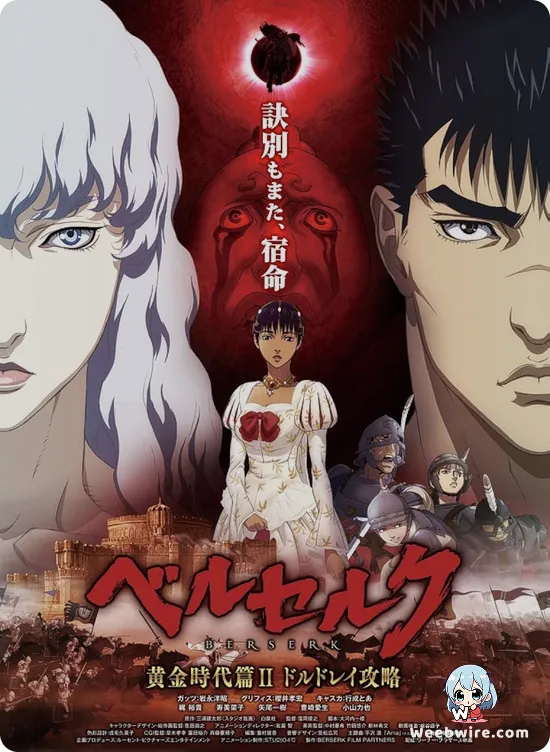
Berserk: The Golden Age Arc II - The Battle for Doldrey
Overview
Berserk: The Golden Age Arc II - The Battle for Doldrey, the second cinematic installment in the acclaimed Berserk film trilogy, plunges viewers back into the brutal, war-torn medieval fantasy world born from Kentaro Miura's legendary manga. This film meticulously adapts the pivotal arc detailing the meteoric rise of Griffith and his elite mercenary unit, the Band of the Hawk. Three years after the formidable, lone swordsman Guts joined Griffith's ranks following a decisive duel, he has become an indispensable force, wielding the colossal Dragonslayer with unmatched lethality. Yet, Guts remains restless, driven by an internal conflict to stand as Griffith's equal, rather than simply a subordinate to the charismatic leader's grand ambition of achieving kingship. The narrative's central conflict escalates with the Band of the Hawk's most daunting undertaking: the siege of Doldrey, a formidable fortress fiercely defended by an army of thirty thousand soldiers from the Empire of Chuder. Griffith orchestrates a daring and ingenious strategy that decisively turns the tide of the protracted conflict, showcasing the Hawks' formidable combat prowess, tactical acumen, and sheer savagery in a series of exhilarating battles. The film culminates in the triumphant recapture of Doldrey, a victory that elevates the Band of the Hawk to the esteemed status of nobility. Parallel to the grand military campaign, the story delves into profound personal struggles. Guts undertakes a perilous rescue of Casca during an intense battle, an ordeal complicated by her sudden incapacitation due to menstrual cramps amidst the slaughter. This leads to a raw, desperate survival scenario after they are both thrown from a precipice. Seeking refuge in a cave while battling fever, their shared vulnerability becomes a catalyst for Casca to reveal her traumatic past—a past where she was rescued from an assault by a young Griffith—thereby deepening their complex bond and hinting at the unspoken emotional undercurrents between them. Griffith's manipulative genius is on full display as he deftly persuades Midland's wavering generals, while subplots unflinchingly explore the dehumanizing horrors inherent in warfare, depicted through the grim reality of sex slaves within Doldrey and Griffith's own scandalous liaison with the fortress governor's concubine. The film reaches its dramatic crescendo with Guts' resolute decision to depart the Band of the Hawk following their monumental victory. This decision ignites an emotionally charged duel between Guts and Griffith atop a snow-covered hill, a confrontation that starkly underscores the film's central themes of ambition, loyalty, and the inexorable divergence of destinies. Unique elements that define this installment include its breakneck pacing, seamlessly blending hyper-violent action sequences with moments of poignant character introspection. The use of widescreen vistas effectively amplifies the sheer scale of the battles, and subtle narrative deviations from Miura's original manga serve to heighten the emotional impact of key scenes. All of this is rendered with Studio 4°C's characteristically detailed animation, which faithfully captures the dark, gritty, and visceral essence of the source material. This 90-minute epic masterfully balances breathtaking spectacle with introspective character development, immersing viewers in a world where heroism is forged in the crucible of blood and where soaring dreams inevitably collide with a harsh, unforgiving reality.
Opinion
Berserk: The Golden Age Arc II - The Battle for Doldrey stands as a remarkable achievement within the film trilogy, masterfully balancing relentless, high-octane action with profound emotional resonance. The narrative propels forward with an urgent momentum, transitioning from intense personal skirmishes to the monumental Battle for Doldrey. Griffith's ingenious strategic deployment, culminating in the Band of the Hawk's hard-fought triumph against overwhelming odds, feels both exhilarating and richly deserved, showcasing exceptional tactical brilliance amidst a backdrop of visceral, gore-soaked combat. The characterizations are a particular highlight; Guts, in particular, is portrayed with a compelling duality of raw physical power and introspective depth. His solo assault against nearly a hundred soldiers and his desperate heroism alongside Casca on the cliffside forge a powerful arc of mutual reliance, which blossoms into a profound and palpable respect between them. Casca's character is humanized effectively, with her vulnerability—manifested through menstrual cramps incapacitating her mid-battle and her feverish recollections of Griffith's past intervention—adding significant layers to her warrior persona, particularly within the context of gender dynamics in a predominantly male mercenary world. Griffith's enigmatic persona deepens, his confident manipulation of Midland's generals and his post-battle indiscretions subtly hinting at burgeoning hubris. The climactic snowy duel between Guts and Griffith powerfully crystallizes their fractured brotherhood, packing an immense emotional payload into a relatively short duration, a feat few narratives achieve with such impact. The film effectively explores profound themes, including the steep cost of ambition, the fragility of loyalty, and the pervasive dehumanization wrought by constant warfare. Visual representations, such as the expendable soldiers and the enslaved women within Doldrey, unflinchingly reinforce Miura's stark and uncompromising worldview. Studio 4°C's animation is commendable, particularly in its fluid combat choreography and the breathtaking scale of the widescreen battles, such as the iconic decapitation of the rhino knights, and the primal survival sequences that evoke the unforgiving nature of the wild. While occasional stiffness in the CGI elements is noticeable, it does not significantly detract from the overall visual experience, especially when contrasted with the hand-drawn grit often associated with the 1997 anime adaptation. The pacing is a significant strength, allowing quieter dialogue exchanges to carry substantial narrative weight and providing moments of levity that effectively punctuate the pervasive tension. Minor alterations made to the manga's climax infuse fresh poignancy without betraying the original narrative's essence. While some character backstories might feel somewhat underdeveloped, potentially posing a slight challenge for newcomers, and Griffith's descent into darkness is perhaps telegraphed unevenly, these are minor critiques in the face of the film's overall success. For devoted fans of the series, this installment represents a peak moment in the Golden Age Arc, serving as a visceral and emotionally charged prelude to the horrors of the Eclipse, and it certainly warrants repeated viewings. The film's enduring impact is undeniable, cementing Berserk's legacy as a benchmark for dark fantasy storytelling. It masterfully blends heart-pounding action with a soul-crushing sense of impending doom, leaving viewers profoundly affected by the high price of dreams and the delicate nature of bonds. This is an essential watch that encapsulates why Berserk continues to be a defining work in mature anime narrative.
Characters
Griffith
Voice: Takahiro Sakurai
Judeau
Voice: Yuki Kaji
Guts
Voice: Hiroaki Iwanaga
Casca
Voice: Toa Yukinari
Pippin
Voice: Satoshi Ishii
Credits
Studio
Studio 4°C
Cover Art
Kentaro Miura
Publisher
Hakusensha
Producers
Horipro, White Fox, Bandai Visual
Episodes
Season 1
1 episodesInformation
Genres
Related Anime
Fullmetal Alchemist: Brotherhood
Haikyu!!
Attack on Titan
Hunter x Hunter Story, Characters, Revival News, & Similar Anime
Gintama.: Slip Arc